19 Oct 2013
A couple of weeks ago, I had the pleasure to attend Progressive F# Tutorials in NYC. The conference was fantastic – two days of hands-on workshops, great organization by the good folks at SkillsMatter, Rickasaurus and Paul Blasucci, and a great opportunity to exchange with like-minded people, catch up with old friends and make new ones.
After some discussion with Phil Trelford, we decided it would be a lot of fun to organize a workshop around PacMan. Phil has a long history with game development, and a lot of wisdom to share on the topic. I am a total n00b as far as game programming goes, but I thought PacMan would make a fun theme to hack some AI, so I set to refactor some of Phil’s old code, and transform it into a “coding playground” where people could tinker with how PacMan and the Ghosts behave, and make them smarter.
More...
06 Sep 2013
Recently, Cesar De Souza began moving his .NET machine learning library, Accord.NET, from Google Code to GitHub. The move is still in progress, but that motivated me to take a closer look at the library; given that it is built in C#, with an intended C# usage in mind, I wanted to see how usable it is from F#.
There is a lot in the library; as a starting point, I decided I would try out its Support Vector Machine (SVM), a classic machine learning algorithm, and run it on a classic problem, automatically recognizing hand-written digits. The dataset I will be using here is a subset of the Kaggle Digit Recognizer contest; each example in the dataset is a 28x28 grayscale pixels image, the result of scanning a number written down by a human, and what the actual number is. From that original dataset, I sampled 5,000 examples, which will be used to train the algorithm, and another 500 in a validation set, which we’ll use to evaluate the performance of the model on data it hasn’t “seen before”.
More...
25 Aug 2013
About a month ago, FSharp.Data released version 1.1.9, which contains some very nice improvements – you can find them listed on Gustavo Guerra’s blog. I was particularly excited by the changes made to the CSV Type Provider, because they make my life digging through datasets even simpler, but couldn’t find the time to write about it, because of my recent cross-country peregrinations.
Now that I am back, let’s talk about why this update made me so happy, with a concrete example. My latest week-end project is an F# implementation of Random Forests; as part of the process, I am trying out the algorithm on various datasets, to get a sense for potential performance problems, and dog-food my own API, the best way I know to quickly spot suckiness.
One of the problems I ran into was the representation of missing values. Most datasets don’t come clean and ready to use – usually you’ll have a few records with missing data. I opted for what seemed the most straightforward representation in F#, and decided to represent every feature value as an Option – anything can either have Some value, or None.
The original CSV Type Provider introduced a bit of friction there, because it inferred types “optimistically”: if the sample used contained only integers, it would create an integer, which is great in most cases, except when you want to be “pessimistic” (which is usually a safe world-view when setting expectations regarding data).
The new-and-improved CSV Type Provider fixes that, and introduces a few niceties. Case in point: the Kaggle Titanic dataset, which contains the Titanic’s passenger list. With the new version, extracting the data is as simple as this:
type DataSet = CsvProvider<"titanic.csv",
                           Schema="PassengerId=int, Pclass->Class, Parch->ParentsOrChildren, SibSp->SiblingsOrSpouse",
                           SafeMode=true,
                           PreferOptionals=true>

type Passenger = DataSet.Row
This is pretty awesome. In a couple of lines, just by passing in the path to my CSV file and some (optional) schema information, I get a Passenger type:
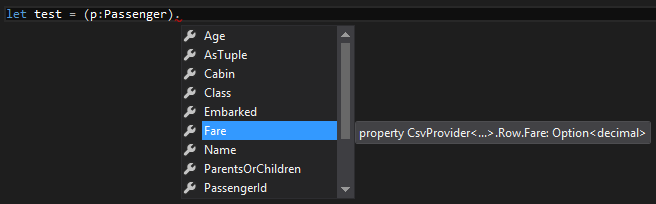
What’s neat here is that first, I immediately get a Passenger with properties – with the correct Optional types, thanks to SafeMode and PreferOptional. Then, notice in the Schema the Pclass->Class, Parch->ParentsOrChildren, SibSp->SiblingsOrSpouse bit? This renames “on the fly” the properties; instead of the pretty obscurely named Parch feature coming from the CSV file header, I get a nice and readable ParentsOrChildren property. The Type Provider even does a few more cool things, automagically; for instance, the feature “Survived”, which is encoded in the original dataset as 0 or 1, gets automatically converted to a boolean. Really nice.
And just like that, I can now use this CSV file, and send it to my (still very much in alpha version) Decision Tree classifier:
// We read the training set into an array,
// defining the Label we want to classify on:
let training =
    use data = new DataSet()
    [| for passenger in data.Data ->
        passenger.Survived |> Categorical, // the label
        passenger |]
// We define what features should be used:
let features = [|
    "Sex", (fun (x:Passenger) -> x.Sex |> Categorical);
    "Class", (fun x -> x.Class |> Categorical); |]
// We run the classifier...
let classifier, report = createID3Classifier training features { DefaultID3Config with DetailLevel = Verbose }
// ... and display the resulting tree:
report.Value.Pretty()
… which produces the following results in the F# Interactive window:
> titanicDemo();;
├ Sex = male
│   ├ Class = 3 → False
│   ├ Class = 1 → False
│   └ Class = 2 → False
└ Sex = female
   ├ Class = 3 → False
   ├ Class = 1 → True
   └ Class = 2 → True
val it : unit = ()
>
The morale of the story here is triple. First, it was a much better idea to be a rich lady on the Titanic, rather than a (poor) dude. Then, Type Providers are really awesome – in a couple of lines, we extracted from a CSV file a collection of Passengers, all of them statically typed, with all the benefits attached to that; in a way, this is the best of both worlds – access the data as easily as with a dynamic language, but with all the benefits of types. Finally, the F# community is just awesome – big thanks to everyone who contributed to FSharp.Data, and specifically to @ovatsus for the recent improvements to the CSV Type Provider!
You can find the full Titanic example here on GitHub
More...
13 Jul 2013
It looks like this summer will be my strangest vacation in a while – I’ll be taking a F# road trip of sorts in August, talking about F# at user groups all over the United States. How this crazy plan took shape exactly I am not quite sure in retrospect, but I am really looking forward to meeting all the local communities – this will be fun!
As of July 13th July 28th, here is the plan:
-
July 31, Sacramento: “Coding Dojo: a gentle introduction to Machine Learning with F#”
-
August 8, Houston: “An Introduction to F# for the C# Developer”
-
August 9, Houston: “Coding Dojo: a gentle introduction to Machine Learning with F#”
-
August 12, Nashville: “Coding Dojo: a gentle introduction to Machine Learning with F#”
-
August 13, Charlotte: “Coding Dojo: a gentle introduction to Machine Learning with F#”
-
August 14, Raleigh: “An Introduction to F# for the C# Developer”
-
August 15, Raleigh: “Coding Dojo: a gentle introduction to Machine Learning with F#”
-
August 16, Washington DC: “Coding Dojo: a gentle introduction to Machine Learning with F#”
-
August 17, Philadelphia: “Coding Dojo: a gentle introduction to Machine Learning with F#”
-
August 19, New York City: “Coding Dojo: a gentle introduction to Machine Learning with F#”
-
August 20, Boston: “An introduction to F# for the C# developer”
-
August 21, Boston: “Coding Dojo: a gentle introduction to Machine Learning“
-
August 22, Detroit: TBA
… and a few more should be added to the list soon! I’ll let you extrapolate what possible cities could be following, given the map below. Stay tuned for updates.
View Larger Map
View Larger Map
Huge thanks to the people who helped make this happen – I am sure I forgot some of you, sorry about that, and I’ll owe you a beer when I visit your city!
… and of course @INETA!
More...
05 Jul 2013
Besides having one of the coolest names around, Random Forest is an interesting machine learning algorithm, for a few reasons. It is applicable to a large range of classification problems, isn’t prone to over-fitting, can produce good quality metrics as a side-effect of the training process itself, and is very suitable for parallelization. For all these reasons, I thought it would be interesting to try it out in F#.
The current implementation I will be discussing below works, but isn’t production ready (yet) – it is work in progress. The API and implementation are very likely to change over the next few weeks. Still, I thought I would share what I did so far, and maybe get some feedback!
The idea behind the algorithm
As the name suggests, Random Forest (introduced in the early 2000s by Leo Breiman) can be viewed as an extension of Decision Trees, which I discussed before. A decision tree grows a single classifier, in a top-down manner: the algorithm recursively selects the feature which is the most informative, partitions the data according to the outcomes of that feature, and repeats the process until no information can be gained by partitioning further. On a non-technical level, the algorithm is playing a smart “game of 20 questions”: given what has been deduced so far, it picks from the available features the one that is most likely to lead to a more certain answer.
How is a Random Forest different from a Decision Tree? The first difference is that instead of growing a single decision tree, the algorithm will create a “forest” – a collection of Decision Trees; the final decision of the classifier will be the majority decision of all trees in the forest. However, having multiple times the same tree wouldn’t be of much help, because we would get the same classifier repeated over and over again. This is where the algorithm gets interesting: instead of growing a Tree using the entire training set and features, it introduces two sources of randomness:
- each tree is grown on a new sample, created by randomly sampling the original dataset with replacement (“bagging”),
- at each node of the tree, only a random subset of the remaining features is used.
More...