08 Jul 2012
I recently spent some time thinking about code performance optimization problems, which led me to dust my old class notes on Queuing Theory. In general, Queuing studies the behavior of networks of Queues, where jobs arrive at various time intervals, and wait in line until they can be processed / served by a Node / Server, potentially propagating new Jobs going to other connected queues upon completion.

Side note: the picture above is not completely random. It depicts the Marsupilami, a fictional creature who is an expert in managing long tails, known in French as “Queues”>
The simplest case in Queues is known as the Single-Server Queue – a queue where all jobs wait in a single line, and are processed by a single server. Single queues are interesting in their own right, and can be found everywhere. They are also important, because they are the building blocks of Networks of Queues, and understanding what happens at a single Queue level helps understand how they work when connected together.
The question we’ll be looking at today is the following: given the characteristics of a Queue, what can we say about its performance over time? For instance, can we estimate how often the Queue will be busy? How many jobs will be backed up waiting for service on average? How large can the queue get? How long will it take, on average, to process an incoming job?
More...
27 Jun 2012
This months’ issue of MSDN Magazine has an interesting piece on evolutionary algorithms. The article applies a genetic algorithm to identify the minimum value of a “pathological” continuous function, the Schwefel function.
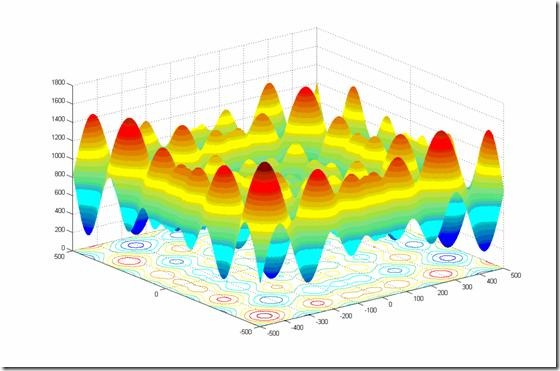 The Schwefel function
For X and Y values between –500 and 500, the “correct” answer is X and Y = 420.9687.
This function is designed to give fits to optimization algorithms. The issue here is that the function has numerous peaks and valleys. As a result, if the search strategy is to use some form of gradient approach, that is, from a starting point, follow the steepest descent until a minimum is reached, there is a big risk to end up in a place which is a local minimum: the algorithm gets stuck in a valley with no path downwards, but there are other, better solutions around, which can be reached only by “climbing out of the hole” and temporarily following a path which heads in the wrong direction.
More...
06 Jun 2012
I have just pushed version 0.3 of Bumblebee on CodePlex. Bumblebee is an Artificial Bee Colony algorithm implementation in F#. In a nutshell, it’s a randomized search method that mimics the behavior of bees looking for food, and can be suitable to find approximate solutions to large scale problems where deterministic approaches are impractical. Bumblebee provides a C#-friendly Solver, which will search for solutions to a problem, sending messages to the caller whenever an improved solution is found, until the search is stopped. It uses the Task Parallel Library to parallelize the searches as much as possible.
The source code includes two sample projects that illustrate the algorithm in action on the Travelling Salesman Problem, one in F#, one in C#, with a “fancy” WPF user interface.
What’s new in Version 0.3? Mostly code cleanup – when I revisited my original code a few months after the fact, I had a hard time following it, so I reorganized things internally in a way which I hope is clearer. The main change from an API perspective is the constructor for C# problems: I removed the Tuples from the Func delegates, which were mostly noise and didn’t help much.
More...
27 May 2012
Markov chains are a classic in probability model. They represent systems that evolve between states over time, following a random but stable process which is memoryless. The memoryless-ness is the defining characteristic of Markov processes, and is known as the Markov property. Roughly speaking, the idea is that if you know the state of the process at time T, you know all there is to know about it – knowing where it was at time T-1 would not give you additional information on where it may be at time T+1.
While Markov models come in multiple flavors, Markov chains with finite discrete states in discrete time are particularly interesting. They describe a system which is changes between discrete states at fixed time intervals, following a transition pattern described by a transition matrix.
Let’s illustrate with a simplistic example. Imagine that you are running an Airline, AcmeAir, operating one plane. The plane goes from city to city, refueling and doing some maintenance (or whatever planes need) every time.
Each time the plane lands somewhere, it can be in three states: early, on-time, or delayed. It’s not unreasonable to think that if our plane landed late somewhere, it may be difficult to catch up with the required operations, and as a result, the likelihood of the plane landing late at its next stop is higher. We could represent this in the following transition matrix (numbers totally made up):
| Current \ Next |
Early |
On-time |
Delayed |
| Early |
10% |
85% |
5% |
| On-Time |
10% |
75% |
15% |
| Delayed |
5% |
60% |
35% |
More...
20 May 2012
During a recent Internet excursions, I ended up on the Infinite Monkey Theorem wiki page. The infinite monkey is a somewhat famous figure in probability; his fame comes from the following question: suppose you gave a monkey a typewriter, what’s the likelihood that, given enough time randomly typing, he would produce some noteworthy literary output, say, the complete works of Shakespeare?
Somewhat unrelatedly, this made me wonder about the following question: imagine that I had a noteworthy literary output and such a monkey – could I get my computer to distinguish these?
For the sake of experimentation, let’s say that our “tolerable page” is the following paragraph by Jorge Luis Borges:
Everything would be in its blind volumes. Everything: the detailed history of the future, Aeschylus’ The Egyptians, the exact number of times that the waters of the Ganges have reflected the flight of a falcon, the secret and true nature of Rome, the encyclopedia Novalis would have constructed, my dreams and half-dreams at dawn on August 14, 1934, the proof of Pierre Fermat’s theorem, the unwritten chapters of Edwin Drood, those same chapters translated into the language spoken by the Garamantes, the paradoxes Berkeley invented concerning Time but didn’t publish, Urizen’s books of iron, the premature epiphanies of Stephen Dedalus, which would be meaningless before a cycle of a thousand years, the Gnostic Gospel of Basilides, the song the sirens sang, the complete catalog of the Library, the proof of the inaccuracy of that catalog. Everything: but for every sensible line or accurate fact there would be millions of meaningless cacophonies, verbal farragoes, and babblings. Everything: but all the generations of mankind could pass before the dizzying shelves—shelves that obliterate the day and on which chaos lies—ever reward them with a tolerable page.
Assuming my imaginary typewriter-pounding monkey is typing each letter with equal likelihood, my first thought was that by comparison, a text written in English would have more structure and predictability – and we could use Entropy to measure that difference in structure.
More...